The numbers behind each ward
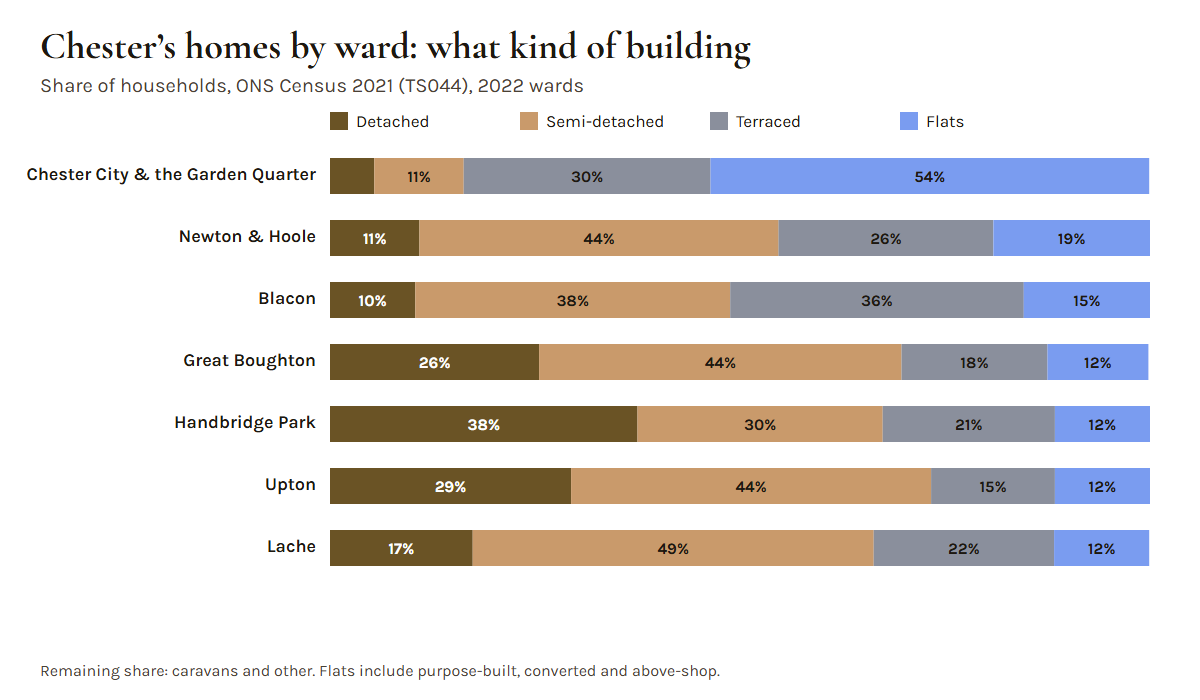
The table shows Census 2021 for the seven 2022 wards that make up the city of Chester, from the Office for National Statistics via Nomis (tables TS044 accommodation type, TS054 tenure and TS046 central heating). Percentages are of households.
| Ward | Households | Owned | Private rent | Detached | Semi | Terraced | Flats | Gas only | Electric only |
|---|---|---|---|---|---|---|---|---|---|
| Chester City & the Garden Quarter | 8,636 | 37.6% | 42.6% | 5.4% | 10.9% | 30.1% | 53.5% | 61.2% | 27.6% |
| Newton & Hoole | 6,702 | 65.4% | 19.7% | 10.9% | 43.8% | 26.2% | 19.1% | 84.3% | 4.9% |
| Blacon | 6,011 | 49.3% | 13.1% | 10.4% | 38.4% | 35.8% | 15.4% | 83.5% | 5.1% |
| Great Boughton | 4,877 | 77.0% | 14.5% | 25.5% | 44.2% | 17.8% | 12.3% | 83.9% | 6.4% |
| Handbridge Park | 4,330 | 73.9% | 19.2% | 37.5% | 29.9% | 21.0% | 11.6% | 84.1% | 5.3% |
| Upton | 3,910 | 74.4% | 12.3% | 29.4% | 43.9% | 15.1% | 11.6% | 85.6% | 5.1% |
| Lache | 2,587 | 52.2% | 18.6% | 17.4% | 48.9% | 22.0% | 11.6% | 83.3% | 4.5% |
| Seven city wards | 37,053 | 58.9% | 22.4% | 17.0% | 34.1% | 25.5% | 23.4% | 78.8% | 10.5% |
| Whole borough | 155,154 | 68.3% | 15.7% | 30.6% | 36.3% | 20.6% | 11.9% | 78.0% | n/a |
Ward by ward: what comes first
Chester City & the Garden Quarter
The largest ward (8,636 households) and the least like the rest: 53.5% of homes are flats, 42.6% are privately rented and only 37.6% are owner-occupied. It also takes in the City Centre conservation area and many listed buildings. For most households here the first question is not the roof but who controls it: the freeholder, the management company or the landlord. The 30.1% who live in terraces, many of them Victorian, face the conservation-area and listing questions in our planning guide. With 27.6% heating by electricity only, the August 2026 balcony and plug-in rules may matter more here than anywhere else in Chester; see flats and balconies.
Newton & Hoole
6,702 households, 65.4% owner-occupied, with semis (43.8%) and terraces (26.2%) making up most of the homes. Hoole Road and Flookersbrook are conservation areas. Terraced roofs here commonly have a chimney stack on each party wall, which shapes the panel layout more than the planning rules do: roof slopes are permitted development in the conservation areas too.
Blacon
6,011 households, the highest share of terraced homes in the city (35.8%) and the highest share of social renting (37.0%). For social tenants, panels are the landlord’s decision. For the 49.3% who own, none of Chester’s thirteen conservation areas is named after Blacon, so for most owners a roof installation is a straightforward permitted development job; homes near the canal should check the Chester Canal conservation area boundary.
Great Boughton
4,877 households and the highest ownership in the city at 77.0%, mostly semis (44.2%) with a quarter detached. Boughton Hall, Dee Banks, Boughton Canalside and Boughton and the Meadows are conservation areas nearby, so check whether a house falls inside one, but expect the roof to be the deciding factor.
Handbridge Park
4,330 households; 73.9% owner-occupied and 46.0% owned outright, the highest outright share among the seven, with 37.5% detached. Queens Park, Handbridge and Curzon Park are all conservation areas, and larger Victorian and Edwardian villas bring tall roofs, slate and scaffold height into the price.
Upton
3,910 households, 74.4% owner-occupied and the highest share heated by gas only (85.6%). Semis (43.9%) and detached houses (29.4%) on wider plots are typical; Upton Park is a conservation area.
Lache
2,587 households, nearly half in semi-detached homes (48.9%) and 28.4% renting from a social landlord. None of the thirteen conservation areas is named after Lache; homes close to Curzon Park should check that boundary with the council.
How the house type changes the job
Terraces
One usable slope, usually the rear; chimney stacks on the party walls; scaffold access through the house or over the pavement. Systems of around 2.5 to 4 kWp are typical. Ask how the layout handles shade.
Semis
Two slopes, front and back, so one usually faces somewhere useful; room for 4 to 5 kWp; often a side passage that eases scaffolding. The most straightforward Chester case.
Detached and villas
More roof, often more shade from mature trees, and taller scaffold on three-storey Victorian houses. Larger systems may need a G99 application to SP Energy Networks first.
Flats
Roof decisions sit with the freeholder or management company. The August 2026 rules add wall and balcony panels and plug-in solar to permitted development, but the lease still decides.
Whatever the type, the output per kWp on an unshaded Chester roof is set by direction and pitch, not by the house: use the roof output estimator. The number of homes that have already gone ahead is rising fast: DESNZ counts 11,740 solar sites across the borough at the end of 2025, up from 5,759 in 2019 (DESNZ). Conservation areas on the city list: Boughton Canalside, Boughton Hall, Boughton and the Meadows, City Centre, Curzon Park, Dee Banks, Flookersbrook, Handbridge, Hoole Road, Liverpool Road, Queens Park, Upton Park, Chester Canal. For how that growth fits the council’s targets, see the climate plan and your home.