Flats are a bigger part of Chester than of the borough
Census 2021 counted 37,053 households in Chester’s seven city wards, and 23.4% of them live in a flat. Across Cheshire West and Chester as a whole the figure is 11.9%, so a Chester household is about twice as likely to live in a flat. Private renting follows the same pattern: 22.4% in the city wards against 15.7% in the borough. The figures come from ONS Census 2021 tables via Nomis, by 2022 ward.
The centre is where it concentrates. In the City & Garden Quarter ward, 53.5% of households live in flats, 42.6% rent from a private landlord and only 37.6% own their home. Heating is different too: 27.6% of households there heat with electricity alone, against 10.5% across the seven city wards.
| Measure | City & Garden Quarter | Seven city wards | Whole borough |
|---|---|---|---|
| Households | 8,636 | 37,053 | 155,154 |
| Live in a flat | 53.5% | 23.4% | 11.9% |
| Rent privately | 42.6% | 22.4% | 15.7% |
| Own their home | 37.6% | 58.9% | 68.3% |
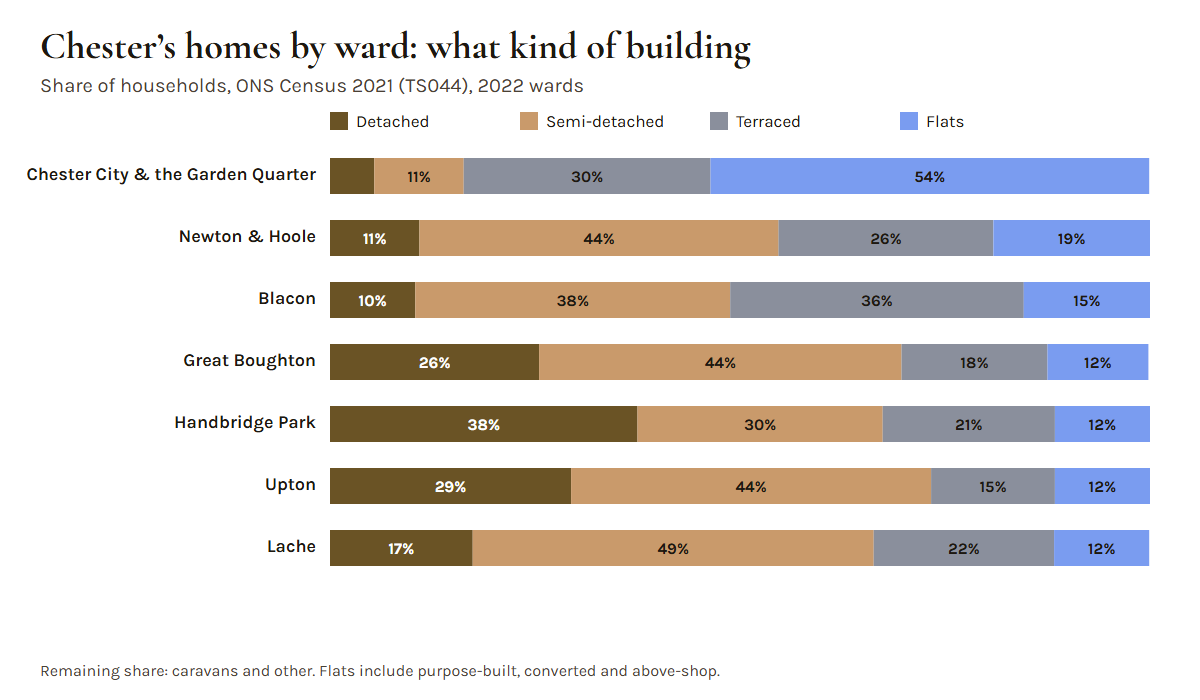
For many people in central Chester the question is not which slope of the roof to use but whose roof it is. That changes the order in which things need to be settled, and it is why this page puts the lease ahead of the hardware.
What the planning rules allow on a block of flats
Part 14 Class A of the General Permitted Development Order covers a block of flats as well as a house, and it also covers buildings within a block’s curtilage, such as a bin store or a row of garages. Since 27 August 2026 the order has kept separate lists of limits for blocks and for houses. For a block that is not listed, the legislation, as amended by SI 2026/896, allows panels as permitted development within these limits:
| Position on a block | Limit | Extra rule in a conservation area |
|---|---|---|
| Pitched roof slope | Within 0.2 m of the slope, and no higher than the roof’s highest point, ignoring chimneys | None beyond the siting condition |
| Flat roof | Up to 0.6 m above the roof’s highest point, ignoring chimneys | A prior-approval determination from the council comes first |
| Wall | No more than 0.2 m beyond the plane of the wall | Not on a wall that fronts a road |
| Plug-in solar | Counts as solar PV, so the same limits apply; never on a wooden wall, balcony or enclosure, or on timber-clad parts of the block | As for other panels |
| Any position on a listed block | No permitted development | Planning permission and Listed Building Consent |
Three differences from the rules for a house are worth knowing. A block has a single 0.2 m projection limit for walls, where a house is allowed 0.4 m on a wall that does not abut a road. In a conservation area, the exclusion for a block names walls that front a road, while the house version also names balconies and roof enclosures. And the list for blocks sets no separate limit for panels on a balcony enclosure at all. If you want panels on the balcony of a block, ask the council how it reads your case, or apply for a Lawful Development Certificate, which is the council’s formal confirmation that a proposal is lawful without a planning application.
The conditions that come with the right are the same for blocks and houses. Panels must be sited, as far as practicable, to keep their effect on the building’s outside appearance and on the amenity of the area as low as possible, and they must be removed as soon as reasonably practicable once they are no longer needed.
Plug-in solar: what the planning change covers
The August 2026 order brought plug-in solar into the legal definition of solar PV. In the order, plug-in solar means panels intended to connect to a home’s electricity installation by means of a standard plug and socket. From 27 August 2026 the position limits above apply to them as to any other panels, with one more exclusion: no part may sit on a wooden wall, balcony or enclosure, or on any timber-clad part of the outside of the block. On a listed block there is no permitted development for them either.
Plug-in panels are not standard in UK homes yet. This page covers only the planning position. It says nothing about equipment or the electrical side, and the planning rules do not settle whether your lease or tenancy allows a plug-in panel. Ask the freeholder, the managing agent or your landlord before you buy anything.
The lease decides before the council does
Owning a flat usually means owning a lease. Many leases keep the roof, the outside walls and the structure of the building with the freeholder, and set out what a leaseholder may alter. Read yours before anything else: it says what is part of your flat, which changes need consent and whose consent that is. If the block has a management company or a residents’ company, that may be the body that decides.
Where the roof belongs to the freeholder, assume you need the freeholder’s written consent until the lease or the freeholder tells you otherwise. A shared roof also raises questions that a house roof never does, and they are easier to settle in writing at the start:
- Who owns the panels, and who insures and maintains them?
- Whose electricity do they supply: one flat, several flats, or the lighting and lifts in the common parts?
- Who pays, and how is the cost shared if the panels serve the whole block?
- What happens when the roof needs repairs and the panels have to come off?
- What happens to the arrangement when a flat is sold?
A block-wide array is also more likely to be large, and larger systems go through a different grid route with SP Energy Networks, where the installer applies before installation rather than notifying afterwards. Our guide to grid connection in Chester explains G98 and G99.
Renting: what a tenant can do
With 42.6% of city-centre households renting privately, many people reading this own no part of the building. A tenant needs the landlord’s consent before anything is fixed to the building, and the same goes for a plug-in panel on a balcony or a wall. Put the request in writing, say where the panels would go and how they would come off, and keep the reply.
If your landlord owns the whole building, panels for the block may be worth raising with them directly. Private tenants can also be eligible for the Warm Homes: Local Grant in west Cheshire, which can include solar PV for homes rated EPC D to G where the household meets one of its eligibility routes, such as the income test. The landlord has to agree, and the council’s support schemes page sets out the landlord’s contribution. Our guide to solar grants in Chester covers who qualifies.
Flats in listed buildings and conservation areas
Some of the centre’s flats are in listed buildings, including around the Rows. If your block is listed, none of the permitted development above applies: panels anywhere on it, plug-in panels included, need planning permission and Listed Building Consent, and fixing them without consent is a criminal offence. Check the building on Historic England’s National Heritage List, then read our guide to listed buildings in Chester for how an application is put together.
If the block is not listed but stands in one of Chester’s thirteen conservation areas, the extra limits concern road-facing walls and flat roofs. The council’s conservation areas page has the appraisal documents, and our conservation-areas guide includes a planning checker for flats as well as houses.
Electric heating and what panels can cover
More than a quarter of households in the City & Garden Quarter ward heat with electricity only. In those homes most of the heating load falls in the colder months, which is when panels in Chester make least: the best roof in the city produces about a quarter as much in December as in May. Our winter output guide has the month-by-month figures.
That does not rule solar out, but it is worth being realistic. Panels will meet more of a flat’s summer and daytime use than its winter heating. A battery can move some daytime output into the evening, and our guide to solar batteries in Chester explains when that helps and the grid step it can trigger.
A sensible order of steps
- Check whether the building is listed. If it is, the route is planning permission and Listed Building Consent, whatever the position.
- Check whether it is in a conservation area. That affects walls fronting a road and flat roofs.
- Read the lease or the tenancy. Find out who owns the roof, the outside walls and the balcony structure.
- Ask in writing. Send the freeholder, management company or landlord the position, size and fixing method you have in mind, and keep the reply.
- Get written quotes for a fixed installation. An MCS installation is needed for export payments under the Smart Export Guarantee. The guide to choosing an installer sets out the checks.
- Settle the grid step. The installer deals with SP Energy Networks, and a larger shared array may need its approval before installation.
Not legal advice. This is our reading of Part 14 as amended, and of the public sources, as at 3 November 2026. The council decides planning matters for Chester, and your lease or tenancy agreement decides what you may do to the building.