Tool · roof output
What would panels make on a Chester roof?
Pick the way your roof faces, its pitch and a system size. The figures come from 56 runs of the EU’s PVGIS model for Chester (PVGIS-SARAH3 sunlight data, 2005-2023), with 14% allowed for cable, inverter and dirt losses. Shade from trees, chimneys and neighbouring buildings is not included.
3,836 kWh a year
959 kWh per kWp · 100% of the best Chester roof (south, 40°)
An estimate for an unshaded roof, not a quote. An MCS installer must give you their own performance estimate for your roof before you sign.
The Chester table: every direction and pitch
The table below is the full grid behind the estimator: kilowatt-hours a year for each kWp of panels, from PVGIS 5.3 for a point in central Chester (53.19° N, 2.89° W), using PVGIS-SARAH3 sunlight data for 2005-2023 and allowing 14% for losses in cables, the inverter and dirt on the glass. The highest figure is shaded darker.
| Roof faces | 10° | 20° | 30° | 35° | 40° | 45° | 50° |
|---|---|---|---|---|---|---|---|
| South | 867 | 919 | 951 | 959 | 962 | 959 | 951 |
| South-east | 845 | 879 | 897 | 901 | 899 | 893 | 882 |
| South-west | 846 | 881 | 900 | 903 | 902 | 896 | 886 |
| East | 792 | 782 | 767 | 757 | 744 | 729 | 712 |
| West | 793 | 784 | 770 | 760 | 748 | 734 | 716 |
| North-east | 737 | 676 | 619 | 592 | 566 | 539 | 513 |
| North-west | 738 | 678 | 622 | 595 | 569 | 544 | 518 |
| North | 714 | 635 | 557 | 518 | 479 | 442 | 406 |
Three things stand out. South-facing roofs barely care about pitch between 30° and 45°: the spread is under 1%. East and west roofs are within a few kilowatt-hours of each other and prefer a shallower pitch. North-facing roofs lose ground fast as the pitch steepens, from 714 kWh at 10° to 406 at 50°.
What the figures leave out
PVGIS models an open roof. Chester roofs are rarely that simple, and four things commonly pull a real system below the table.
- Chimney stacks. Victorian and Edwardian terraces in Hoole, Boughton and Handbridge often have stacks on the party walls. A stack shades part of the roof for part of the day, and with a basic string inverter one shaded panel can drag down its neighbours. Optimisers or microinverters limit that; ask how a quote handles it.
- Neighbouring buildings and trees. Tall trees around Curzon Park, Queens Park and the river, and taller buildings in the city centre, cast long shadows when the sun is low. The effect is largest from November to February.
- Roof shape. Hips, dormers, valleys and roof lights cut the usable area, which limits the system size rather than the output per kWp.
- Equipment. Panel temperature, inverter efficiency and degradation over the years all matter. The 14% loss allowance covers typical cases, not every one.
What a Chester roof makes, month by month
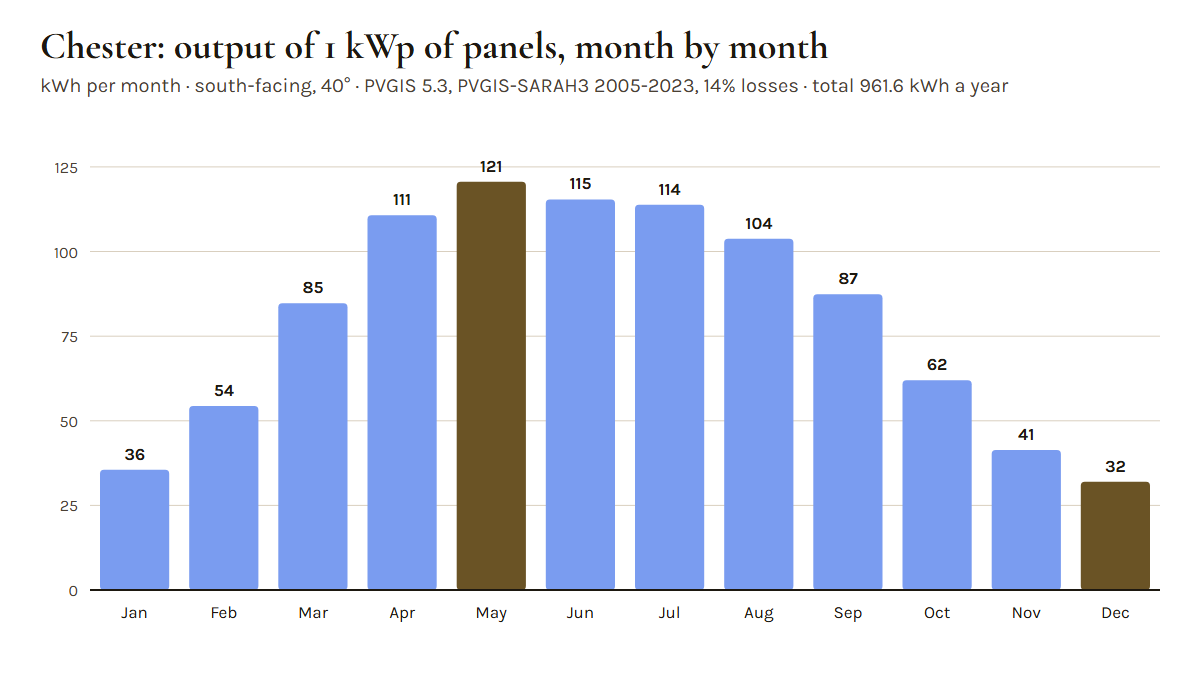
Output peaks from April to August and is lowest in December and January. That matters for how much of it you use at home: in summer a typical array makes more than a household uses in daylight, in winter less. Our winter output guide looks at the dark months in detail.
Turning kilowatt-hours into value
We do not print a savings figure, because it depends on things only you know. Each unit you use in the house is one you do not buy at your import rate; each unit you export earns your chosen Smart Export Guarantee tariff, which differs between suppliers and requires an MCS-certified installation (Ofgem’s SEG guidance). Households that run appliances in daylight, work from home, heat water with surplus power or add a battery use more of their own output.
To work out your own figure, take the estimator’s annual total, decide how much of it you would use yourself, and price that at the unit rate on your bill; price the rest at an export tariff you could actually get. Then compare that with a real quote from the cost guide.
Using the numbers with an installer
Before you sign, an MCS installer must give you a performance estimate for your roof using the MCS method. Put it next to this page. If the installer’s figure is far above the PVGIS figure for your direction and pitch, ask how they got there. If it is well below, ask what shading they have allowed for, because that is the honest reason and you should understand it. The installer guide lists the other questions to ask, and the Chester homes guide shows which roofs are typical in each part of the city.
In the city’s conservation areas a rear slope is often the easier choice, and the table shows what that costs: compare the figure for the rear slope’s direction with the front’s. The guide to conservation areas in Chester explains when a front slope is still allowed and what the siting condition asks for.